





What Is Redux Toolkit?
 Benefits of Using Redux Toolkit
Redux Toolkit (RTK) is the official, opinionated, batteries-included toolset for efficient Redux development, built directly by the Redux team. It was created to solve the biggest complaints developers had about traditional Redux: too much boilerplate, too many packages, and store setup that felt unnecessarily complicated.
In simple terms: Redux Toolkit simplifies Redux by giving you ready-made tools for the most common tasks — creating slices, managing reducers, and configuring your store — while nudging you toward best practices automatically.
Why Was Redux Toolkit Created?Redux Toolkit exists to answer three recurring complaints from the developer community:
⦁ “Configuring a Redux store is too complicated”
⦁ “I have to add a lot of packages to get Redux to do anything useful”
⦁ “Redux requires too much boilerplate code”
Inspired by tools like create-react-app, the Redux team built RTK to abstract away repetitive setup work and bundle in the utilities most developers were already reaching for.
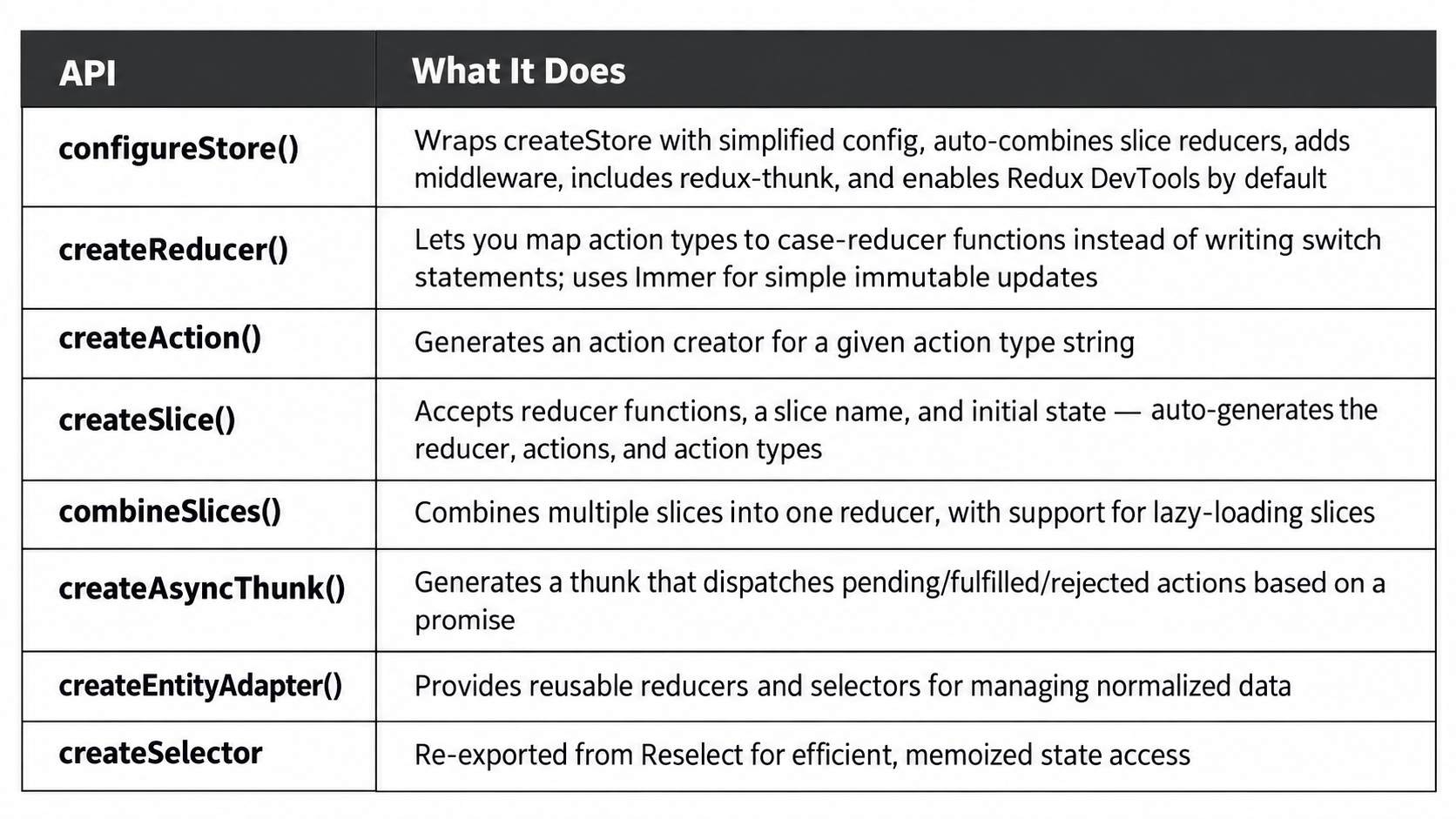
What's Included in Redux Toolkit? (Core APIs)
RTK also includes RTK Query — a built-in data-fetching and caching solution that can eliminate the need to hand-write your own fetching logic.
How Does Redux Work?Before diving deeper into Redux Toolkit, it helps to understand the four building blocks it's built on top of:
The Store
The Redux store is a centralized container holding your entire application's state — think of it as a box with compartments for different types of data (strings, numbers, arrays, objects). It's the single source of truth every component can read from and write to.
Actions
An action is a plain object describing what happened — the only way to send data into the store. Every action needs a type property. (Analogy: an action is like a recipe — it tells the store exactly what change to make.)
Dispatch
dispatch is the function that sends an action to the store, which then runs it through your reducers. (Analogy: dispatch is a mail carrier delivering an action to the right reducer/department.)
Reducers
A reducer is a pure function that takes the current state and an action, and returns new state. (Analogy: a reducer works like a blender — inputs go in, a new “state” comes out.)
The data flow, step by step:
- User interacts → component dispatches an action
- Reducer receives the action → updates state accordingly
- Store updates with the new state
- UI re-renders with the new data
Benefits of Using Redux Toolkit
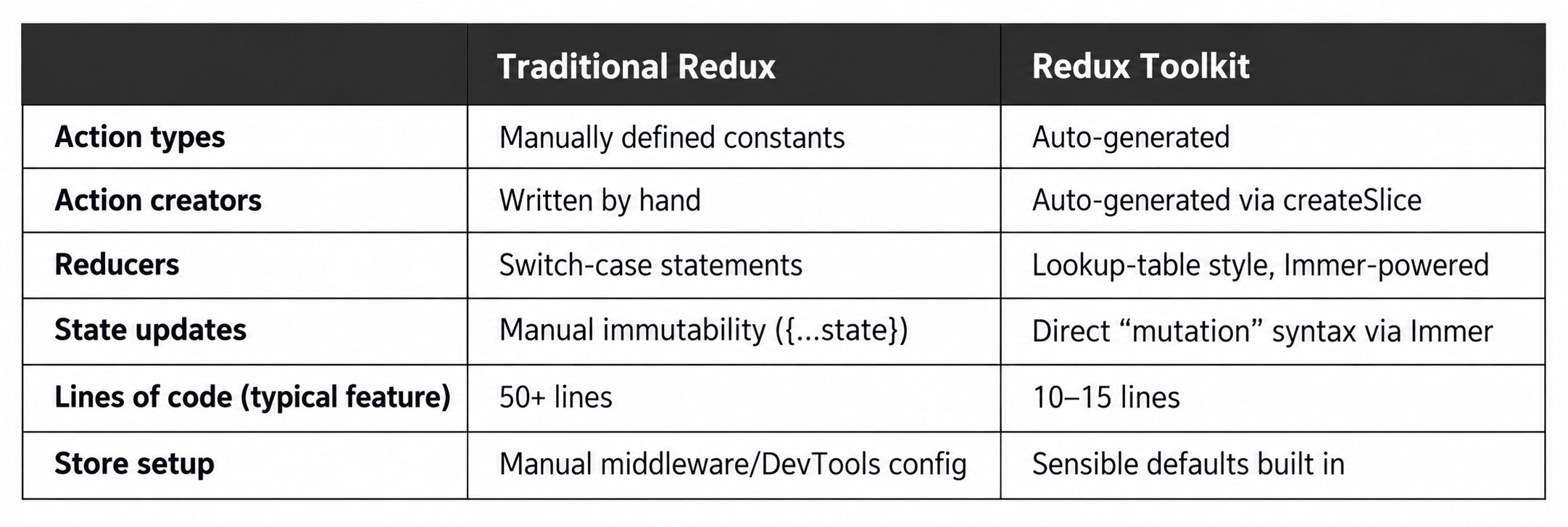
- Less boilerplate — one slice file replaces separate action, reducer, and type files
- Faster setup — fewer dependencies, less configuration
- Built-in best practices — Redux Thunk and Redux DevTools are included by default
- Simpler state updates — Immer lets you write “mutating” code that's actually immutable under the hood
- Better developer experience — less time on setup, more time on logic
Redux Toolkit is the right fit when you're building:
⦁ Large-scale apps with complex, interconnected state
⦁ Products maintained by cross-functional or larger teams that need consistent patterns
⦁ Apps that benefit from time-travel debugging or reproducible actions
⦁ Any new Redux project (RTK is now the officially recommended way to write Redux — there's little reason to start with “plain” Redux in 2026)
Real-World Example: Redux Toolkit in an E-Commerce AppImagine an e-commerce admin dashboard handling:
⦁ User authentication — login/logout, session state
⦁ Product management — CRUD operations, inventory tracking
⦁ Order processing — order status, payments
⦁ Analytics — sales reports, user metrics
Without Redux Toolkit: each feature needs its own hand-written action creators, action types, reducers, and selectors — often hundreds of lines of repetitive code.
With Redux Toolkit: each feature becomes a self-contained “slice” handling its own state, actions, and logic in a fraction of the code.
Challenges & Limitations of Redux ToolkitRTK simplifies Redux, but it isn't magic:
⦁ Still requires Redux fundamentals — you need to understand actions, reducers, and the store to use RTK effectively
⦁ Abstraction trade-off — some underlying Redux mechanics are hidden, which can make debugging less transparent for beginners
⦁ Learning curve for RTK-specific patterns — debugging effectively means understanding RTK's internal abstractions, not just Redux's
ConclusionRedux Toolkit simplifies state management by reducing boilerplate, enforcing best practices, and improving the overall developer experience — without sacrificing the flexibility Redux is known for. Whether you're starting a new project or refactoring an existing one, RTK is the modern standard for writing Redux code.
Frequently Asked QuestionsIs Redux Toolkit the same as Redux?
No. Redux Toolkit is built on top of Redux — it's the officially recommended toolset for writing Redux logic with less code, not a replacement for Redux itself.
Do I need to learn Redux before Redux Toolkit?
A basic understanding of Redux concepts (store, actions, reducers) helps, but RTK is designed to be approachable for newcomers too since it removes most manual setup.
What is RTK Query used for?
RTK Query is Redux Toolkit's built-in data-fetching and caching tool — it can replace hand-written fetch logic, loading states, and caching code.
Is Redux Toolkit still relevant in 2026?
Yes — it remains the official, recommended way to write Redux and is standard in most production React/Redux applications.