





Introduction
Artificial Intelligence is evolving faster than ever, and businesses are no longer asking if they should use AI — they are asking how fast they can implement it.
One technology leading this transformation is LangChain.
From AI chatbots and virtual assistants to autonomous AI agents and workflow automation, LangChain has become one of the most important frameworks for building modern AI-powered applications in 2026.
If you are new to AI development, this beginner-friendly guide explains:
- What LangChain is
- How it works
- Why developers use it
- Key features and components
- Real-world use cases
- Key Benefits
- Why LangChain matters in 2026
Whether you are a startup founder, business owner, or software developer, this guide will help you understand why LangChain is shaping the future of AI applications.
What Is LangChain?
LangChain is an open-source framework designed to help developers build applications powered by Large Language Models (LLMs).
It simplifies the process of connecting AI models with:
- External data sources
- APIs
- Databases
- Tools
- Memory systems
- User workflows
Instead of building complex AI systems from scratch, developers use LangChain to create intelligent applications faster and more efficiently.
In simple terms:
LangChain acts as a bridge between AI models and real-world applications.
It enables AI systems to think, retrieve information, remember conversations, and perform actions automatically.
Why LangChain Is Important in 2026
AI applications in 2026 are no longer limited to simple chatbots.
Businesses now require AI systems that can:
- Access live business data
- Automate workflows
- Integrate with CRMs and ERP systems
- Handle customer support
- Generate reports
- Execute tasks autonomously
- Work across multiple AI models
This is where LangChain becomes valuable.
Developers use LangChain to create:
- AI agents
- Multi-agent systems
- AI copilots
- Retrieval-Augmented Generation (RAG) systems
- AI automation tools
- AI-powered search engines
- Intelligent SaaS platforms
As AI adoption continues to grow globally, LangChain has become a foundational technology for modern AI development.
How Does LangChain Work?
LangChain works by connecting multiple AI-related components together.
Here’s a simplified workflow:
- User enters a query
- LangChain sends the request to an LLM
- The framework retrieves relevant information
- AI processes the context
- The application generates an intelligent response
- Optional tools or APIs execute tasks automatically
This architecture helps developers build smarter AI systems with memory, reasoning, and automation capabilities.
Real-World Example of LangChain
A common use case of LangChain is building AI-powered customer support assistants for e-commerce businesses.
Using LangChain, companies can create AI systems that retrieve product information, answer customer queries, track orders, update CRM systems, and escalate complex issues to human agents automatically.
By combining LLMs, APIs, memory systems, vector databases, and AI agents, LangChain helps businesses deliver faster, more personalized, and context-aware customer support experiences.
Core Components of LangChain
Understanding the main components of LangChain is essential for beginners.
1. LLMs (Large Language Models)
LangChain supports multiple AI models including:
- GPT models
- Claude
- Gemini
- Open-source LLMs
It allows developers to switch between providers without rebuilding the entire application.
2. Prompts
Prompts define how AI responds to user input.
LangChain helps developers create structured prompts for:
- Customer support
- AI assistants
- Content generation
- Data analysis
- Code generation
Prompt optimization improves response accuracy and consistency.
3. Chains
Chains connect multiple actions together.
For example:
- Retrieve data
- Analyze information
- Generate output
- Execute automation
This creates advanced AI workflows instead of single-step responses.
4. Memory
Memory allows AI applications to remember previous conversations and interactions.
This is essential for:
- AI chatbots
- Virtual assistants
- Customer support systems
- AI sales assistants
Without memory, AI conversations feel disconnected.
5. Agents
Agents are one of LangChain’s most powerful features.
AI agents can:
- Make decisions
- Use tools
- Search the web
- Access databases
- Execute tasks autonomously
In 2026, AI agents are becoming a major trend in enterprise automation.
6. Retrieval-Augmented Generation (RAG)
RAG allows AI systems to retrieve real-time or private business data before generating responses.
This improves:
- Accuracy
- Context awareness
- Business intelligence
- Enterprise AI performance
RAG is widely used in AI-powered enterprise solutions today.
Key Features of LangChain
Easy AI Integration
LangChain simplifies integration with:
- APIs
- Databases
- Cloud services
- Vector databases
- External tools
This reduces development complexity.
Multi-Model Support
Developers can use multiple AI models within a single application.
This flexibility helps businesses optimise performance and cost.
AI Workflow Automation
LangChain enables intelligent automation for:
- Marketing
- Sales
- Customer service
- Operations
- Analytics
AI automation is becoming a competitive advantage for businesses worldwide.
Scalability
LangChain supports enterprise-grade AI systems capable of handling large-scale applications and workflows.
Open-Source Ecosystem
Being open-source allows developers to:
- Customize functionality
- Contribute to improvements
- Access community support
- Build flexible AI architectures
This has accelerated LangChain adoption globally.
Real-World Use Cases of LangChain
AI Chatbots
Businesses use LangChain to create intelligent chatbots capable of understanding context and maintaining conversations.
AI Customer Support Systems
AI-powered support agents can:
Answer FAQs
- Resolve tickets
- Retrieve company documentation
- Escalate issues automatically
This improves customer experience while reducing operational costs.
AI-Powered Search Engines
LangChain helps developers build semantic search systems that provide more accurate and context-aware results.
AI Sales Assistants
Sales teams use AI assistants for:
- Lead qualification
- Email generation
- CRM updates
- Meeting summaries
- Sales insights
Enterprise AI Automation
Organisations automate repetitive workflows using AI agents connected through LangChain.
Examples include:
- HR automation
- Finance operations
- IT support
- Document processing
Benefits of Using LangChain
Faster Development
Developers can build AI applications significantly faster using pre-built components and integrations.
Reduced Complexity
LangChain simplifies advanced AI workflows that would otherwise require extensive coding.
Improved AI Accuracy
RAG and memory systems help improve contextual understanding and response quality.
Better User Experience
Applications become more intelligent, personalized, and conversational.
Future-Proof AI Architecture
LangChain supports evolving AI technologies and model ecosystems.
This helps businesses stay competitive in the rapidly changing AI landscape.
The Future of LangChain in 2026 and Beyond
LangChain is expected to play a major role in:
- Autonomous AI systems
- AI workflow orchestration
- Enterprise AI automation
- AI copilots
- Multi-agent collaboration
- Personalized AI experiences
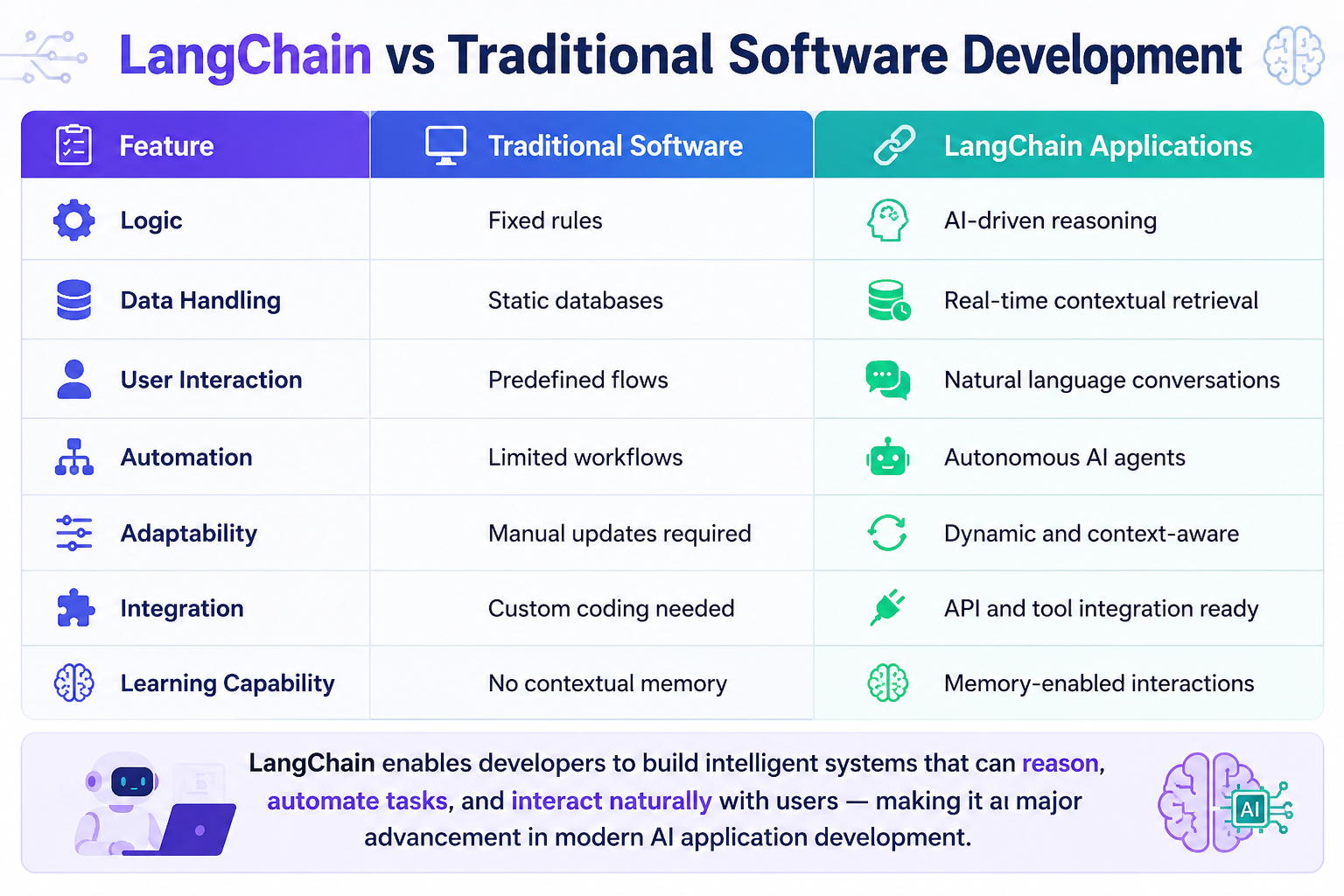
As businesses continue investing in AI transformation, frameworks like LangChain will remain central to AI application development.
Final Thoughts
LangChain is transforming how developers build intelligent applications in 2026.
By simplifying AI integration, workflow automation, memory management, and agent-based architectures, LangChain enables businesses to create smarter and more scalable AI solutions.
For beginners entering the world of AI development, learning LangChain is a valuable step toward building next-generation AI applications.
Whether you want to create AI chatbots, enterprise automation tools, or intelligent SaaS platforms, LangChain provides the foundation needed to innovate faster in the AI era.
Ready to Build AI Applications with LangChain?
At Golden Eagle IT Technologies, we help businesses develop scalable AI-powered applications using LangChain, AI agents, RAG systems, and modern LLM frameworks.
Frequently Asked Questions (FAQs)
What is LangChain used for?
LangChain is used to build AI-powered applications such as chatbots, AI agents, automation systems, and Retrieval-Augmented Generation (RAG) applications.
Is LangChain free to use?
Yes, LangChain is open-source and free to use, though some connected AI models or APIs may require paid access.
Can beginners learn LangChain?
Yes. Beginners with basic Python or JavaScript knowledge can start learning LangChain through tutorials and simple AI projects.
Does LangChain support multiple AI models?
Yes. LangChain supports multiple LLM providers, including GPT, Claude, Gemini, and open-source models.
Why is LangChain popular in 2026?
LangChain is popular because it simplifies AI application development, automation, agent creation, and enterprise AI integration.