





Building an AI application is not just about choosing the right LLM. The real challenge begins when the model needs to work with business-specific information or perform a task in a highly consistent way.
This is where many AI projects reach an architectural crossroads. Should the application retrieve information from a company's knowledge base through Retrieval-Augmented Generation (RAG)? Should the model be customized through fine-tuning? Or does the use case require both?
Choosing incorrectly can increase development complexity, infrastructure requirements, and maintenance costs. Fine-tuning a model when the real requirement is access to frequently changing information may create unnecessary overhead. Similarly, adding a retrieval layer will not solve a problem caused by inconsistent task behavior or output patterns.
The decision becomes clearer when you understand what each approach is designed to solve.
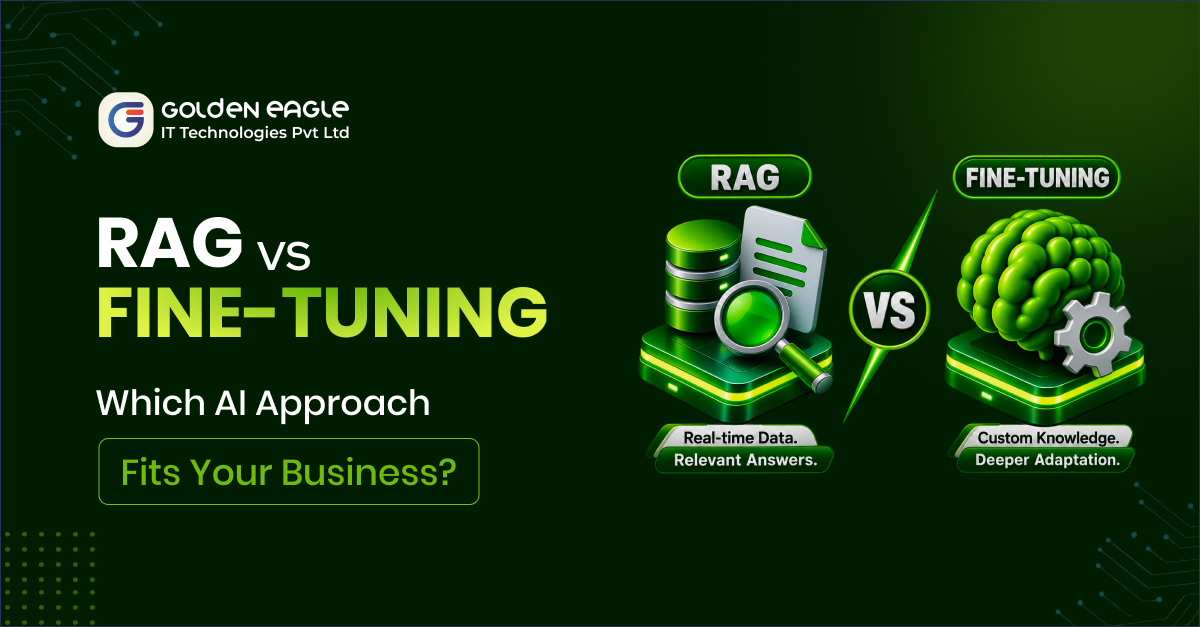
RAG is primarily used to give an LLM access to relevant external information at runtime, while fine-tuning is used to adapt a pretrained model to specific tasks or behaviors. When an application needs both current knowledge and specialized behavior, the two approaches can also be combined.
This guide explains the differences between RAG and fine-tuning, where each approach fits, their limitations, and when a hybrid architecture makes sense.
RAG vs Fine-Tuning: Key Differences
-----
- What Is RAG?
Retrieval-Augmented Generation (RAG) is an AI architecture that connects a large language model with external knowledge sources.
Instead of relying entirely on information learned during pretraining, a RAG application retrieves relevant information when a user submits a query. The retrieved context is then provided to the LLM, which uses it to generate a response.
A simplified RAG workflow is:
User Query → Retrieval → Relevant Context → LLM → Response
The knowledge source could contain:
- Internal company documents
- Product documentation
- Customer support content
- Policies and procedures
- Databases
- Knowledge bases
- Websites
- Technical manuals
A typical RAG pipeline may involve document ingestion, chunking, embeddings, vector or hybrid search, retrieval, reranking, context assembly, and response generation.
For example, an enterprise may build an AI assistant that answers questions about its internal policies. If those policies change, the organization can update the underlying knowledge source instead of retraining the entire model for every change.
That makes RAG particularly useful when information is private, dynamic, or too extensive to manage through prompts alone.
When Should Businesses Use RAG?
RAG is generally a strong choice when the primary challenge is information access.
Businesses should consider RAG when:
- The AI needs access to proprietary information.
- Business information changes regularly.
- Users need responses grounded in specific documents.
- The application needs to search large knowledge repositories.
- Information must remain connected to existing business systems.
- The organization wants to update knowledge without retraining the base model.
Common RAG Use Cases
Enterprise Knowledge Assistants: Employees can query internal policies, processes, technical documentation, and company resources.
Customer Support: AI assistants can retrieve relevant product information and troubleshooting content before generating responses.
Document Q&A: Users can ask questions across contracts, reports, manuals, and other business documents.
Enterprise Search: RAG can combine retrieval with LLM-generated responses to make large information repositories easier to navigate.
However, RAG does not automatically guarantee accurate answers.
The quality of the final response depends heavily on the retrieval pipeline. Poor source data, weak chunking, irrelevant search results, outdated documents, or ineffective ranking can result in poor context being passed to the LLM.
For production systems, businesses should evaluate retrieval accuracy, source quality, access controls, security, latency, monitoring, and response quality rather than treating RAG as a plug-and-play solution.
What Is Fine-Tuning?
Fine-tuning involves taking a pretrained model and training it further on a carefully curated dataset.
The goal is to improve performance for a particular task, behavior, format, or domain requirement.
Unlike RAG, fine-tuning does not primarily provide the model with live external information at query time. Instead, additional training changes the model so it can better reproduce the desired behavior.
Consider a business that receives thousands of customer requests and wants an AI system to classify them into predefined categories. The company may also require a consistent structured output.
If prompting and other model configuration techniques are not delivering sufficient consistency, fine-tuning may be worth evaluating.
Fine-tuning can be useful for:
- Specialized classification
- Consistent output structures
- Domain-specific terminology
- Particular response patterns
- Specialized task execution
- Stable and repeatable workflows
The quality of the training dataset is critical. Fine-tuning with inconsistent, noisy, or poorly labeled examples can produce unreliable results.
When Should Businesses Use Fine-Tuning?
Fine-tuning is more relevant when the primary problem is model behavior rather than knowledge retrieval.
It may be appropriate when:
- The AI needs to perform a specialized task consistently.
- A particular output format must be followed repeatedly.
- The desired behavior is relatively stable.
- Prompting alone does not provide sufficient consistency.
- The organization has high-quality training examples.
For example, a business may need an AI system to classify customer feedback according to a specific taxonomy. The requirement is not necessarily to retrieve changing information. The requirement is for the model to perform a particular task consistently.
That makes fine-tuning a potential solution.
However, fine-tuning should not be treated as a universal way to add business knowledge to an LLM. If the information changes frequently, maintaining an external knowledge source through RAG may be more practical.
RAG vs Fine-Tuning: Which Is Better?
Neither approach is universally better.
RAG is generally better suited to applications that need access to current, proprietary, or external information.
Fine-tuning is generally better suited to applications that need specialized task performance or consistent model behavior.
For example, consider an AI-powered product support system.
If the system needs to answer questions using the latest product specifications, troubleshooting documentation, and policies, RAG is likely to be more relevant because those sources can change over time.
If the system needs to consistently classify support tickets into a predefined taxonomy or produce a particular structured output, fine-tuning may be worth evaluating.
The key question is not:
“Which technology is more advanced?”
It is:
“What is preventing the AI application from delivering the required result?”
That question should drive the architecture.
Can RAG and Fine-Tuning Be Used Together?
Yes. RAG and fine-tuning can complement each other when an application requires both current knowledge and specialized behavior.
A hybrid architecture could use fine-tuning to improve task-specific behavior while RAG provides relevant and up-to-date information from approved enterprise sources.
For example, an enterprise customer support assistant could be designed to follow a specific response structure while retrieving the latest troubleshooting documentation from an internal knowledge base.
In this scenario:
Fine-tuning supports specialized behavior.
RAG provides relevant knowledge.
This combination can be valuable for complex enterprise workflows. However, it also introduces additional components, engineering requirements, evaluation work, and maintenance.
A hybrid architecture should therefore be justified by the application's requirements rather than adopted simply because it appears more sophisticated.
Common Mistakes Businesses Make
1. Fine-Tuning Just to Add Changing Information
If a company wants an AI assistant to work with frequently changing policies, product information, or documentation, fine-tuning may not be the most practical starting point.
A retrieval system can provide access to updated information without requiring the model to be retrained whenever the source content changes.
2. Assuming RAG Eliminates Hallucinations
RAG can improve grounding, but it does not guarantee factual accuracy.
If the retrieval system returns irrelevant, incomplete, or outdated information, the LLM can still produce an unsuitable response.
Strong source governance, retrieval evaluation, access control, monitoring, and response testing remain essential.
3. Fine-Tuning Without a Clear Objective
Fine-tuning should solve a clearly defined performance problem.
Before training, teams should establish what behavior needs to improve, prepare representative examples, and define measurable evaluation criteria.
4. Choosing Technology Before Defining the Use Case
This is one of the most common architectural mistakes.
Instead of starting with:
“Should we use RAG or fine-tuning?”
start with:
“What does our AI application need to do that it cannot reliably do today?”
Once that is established, the technology decision becomes much more straightforward.
How to Choose Between RAG and Fine-Tuning
Use this practical framework:
Choose RAG when:
- Your application needs current information.
- The data is proprietary or stored externally.
- Information changes frequently.
- The primary challenge is knowledge retrieval.
- Users need responses grounded in business sources.
Consider Fine-Tuning when:
- The application requires specialized model behavior.
- A specific task must be performed consistently.
- Output patterns need to be highly repeatable.
- You have sufficient high-quality training examples.
- The desired behavior is relatively stable.
Consider Both when:
- The application requires current enterprise knowledge.
- It also needs specialized task behavior.
- The additional engineering complexity is justified.
- Both retrieval and model behavior have measurable business requirements.
Before selecting an architecture, businesses should also assess data security, governance, latency, scalability, infrastructure, model evaluation, maintenance, and total cost of ownership.
Frequently Asked Questions
Is RAG better than fine-tuning?
Neither is universally better. RAG is generally more suitable when an AI application needs current or proprietary information, while fine-tuning is more relevant when the objective is specialized task behavior or consistent output.
Does RAG require fine-tuning?
No. RAG can connect an existing LLM to external information without fine-tuning the model. Whether additional model customization is necessary depends on the application's specific performance requirements.
Does fine-tuning give an LLM access to the latest information?
Not reliably. Fine-tuning is intended to adapt model behavior using training data. For frequently changing information, an external retrieval system can be more practical because the knowledge source can be updated independently.
Can RAG and fine-tuning be used together?
Yes. A hybrid architecture can use fine-tuning for specialized behavior while RAG provides current information from external or enterprise knowledge sources.
Which approach is better for enterprise AI applications?
It depends on the use case. RAG is often a strong fit for enterprise knowledge and document-based applications, while fine-tuning can be useful for specialized tasks requiring consistent behavior. Complex applications may benefit from both.
Final Takeaway
The RAG vs fine-tuning decision should not be treated as a competition between two AI technologies.
They address different layers of an AI application.
RAG helps an LLM access relevant external knowledge. Fine-tuning helps adapt the model to specific tasks or behaviors.
If the challenge is current, private, or changing information, RAG is often the logical starting point.
If the challenge is specialized task performance or consistent behavior, fine-tuning may be more appropriate.
If the application requires both, a hybrid RAG and fine-tuning architecture can be considered.
The strongest AI implementations start with the business requirement and work backward to the technology—not the other way around.
At Golden Eagle IT Technologies, we help businesses design and develop practical generative AI solutions around their data, workflows, and operational requirements. From RAG-powered enterprise knowledge systems to customized LLM applications and intelligent AI workflows, our focus is on building solutions that are scalable, maintainable, and aligned with measurable business outcomes.
The goal is not to choose the most complex AI architecture. It is to choose the architecture that solves the right problem.