





Maximise efficiency with a GitOps workflow that ensures predictable environments, automated pipelines, and robust version control. Read more.
What is GitOps in DevOps? Workflow, Tools, and Benefits Explained (2026)
As modern applications grow in complexity, businesses need a reliable and automated way to manage both infrastructure and deployments. GitOps is a modern DevOps practice that enables teams to handle infrastructure and application configurations using Git as the central system of record.
Whether you're working with Kubernetes, cloud platforms, or microservices, this approach helps streamline operations, improve deployment speed, and reduce human error.
What is GitOps?
GitOps is a DevOps methodology that uses Git repositories as the central source of truth to manage infrastructure and application deployments through automated workflows.
Key Principles of GitOps Workflow
- Infrastructure code, deployment manifests, and configuration files are stored in Git repositories
- Git defines the desired system state
- Changes are introduced via pull requests or commits
- Automated tools (like Flux or Argo CD) monitor repositories and apply updates
- Manual intervention is minimised through version-controlled operations
This structured GitOps workflow ensures consistency and reduces human error.
GitOps in Action: A Step-by-Step Example

Here’s a practical scenario to illustrate how GitOps works:
- A platform engineering team provisions a Kubernetes cluster using tools like Terraform.
- The cluster’s configuration files are maintained in a Git repository.
- Once the cluster is ready, tools like FluxCD and Helm are used to manage deployments.
- When scaling or updating the infrastructure, the team modifies the configuration files and pushes the changes to Git.
- The system automatically detects these changes and updates the live environment accordingly.
- Meanwhile, developers build container images and store them in a container registry.
- Applications are deployed using Kubernetes manifests or Helm charts stored in Git.
Result: The entire system—from infrastructure to applications—is managed through version-controlled workflows, enabling seamless deployment automation.
DevOps vs GitOps: Understanding the Key Differences
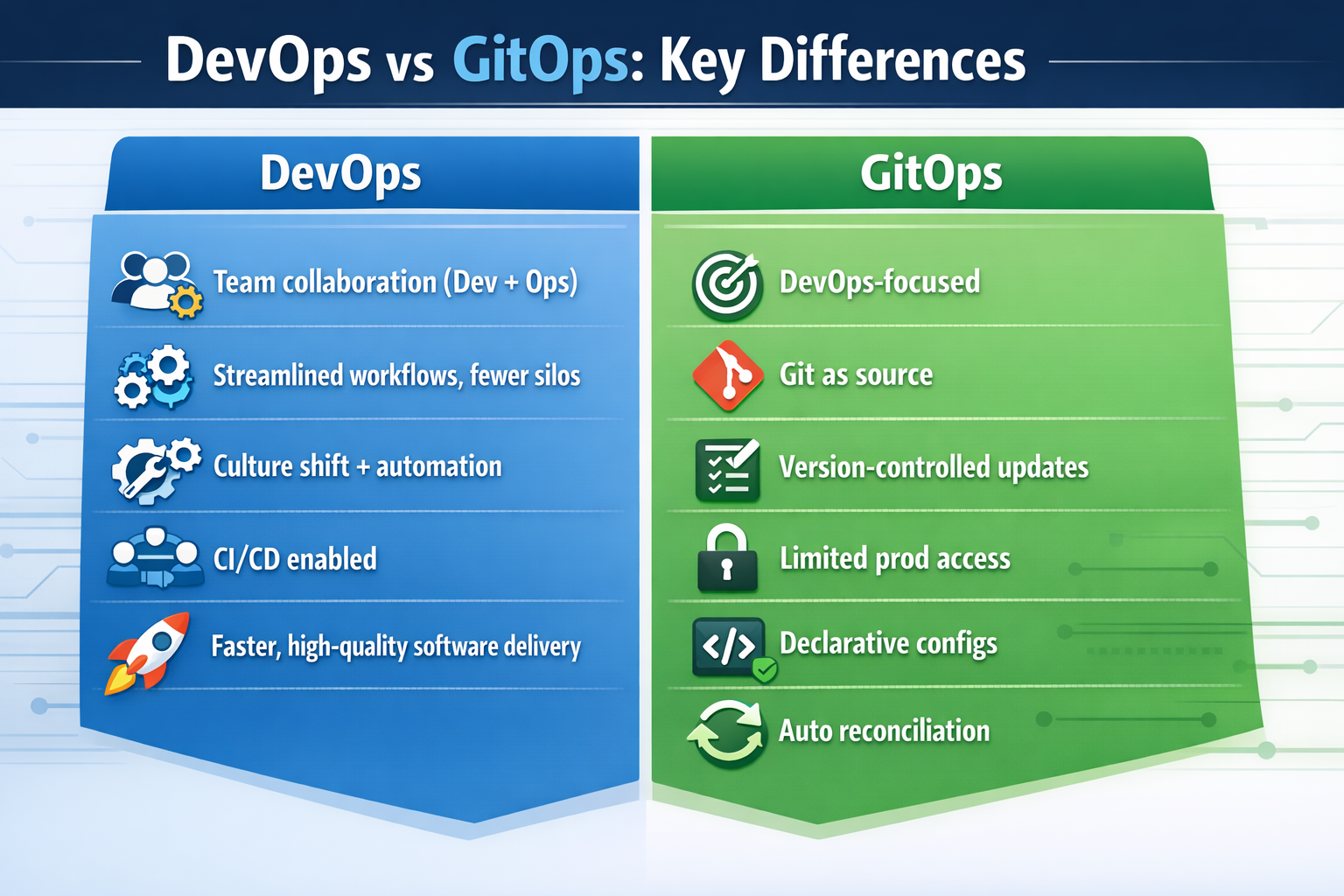
DevOps
- Promotes collaboration between development and operations teams
- Focuses on improving workflows and reducing silos
- Involves cultural changes, automation, and tooling
- Supports continuous integration and delivery (CI/CD)
- Aims to enhance software delivery speed and quality
GitOps
- A focused approach within the DevOps ecosystem
- Uses Git repositories as the central reference point for infrastructure and application code
- Ensures all updates are version-controlled, trackable, and auditable
- Limits direct access to production systems
- Relies on declarative configurations (e.g., Kubernetes manifests, Terraform files)
- Uses reconciliation loops to align the actual system state with the intended configuration
Top Benefits of Implementing GitOps
1. Continuous Delivery by Default
- Enables faster, safer, and automated releases
- Changes can be tested and deployed through CI/CD pipelines
- Faster delivery without compromising stability
- Teams implementing DevOps automation services often leverage GitOps to maximise efficiency
2. Transparent and Verifiable Changes
- All modifications are recorded through commits and pull requests
- Every update can be reviewed, approved, or reverted
- Improves visibility and accountability across teams
3. Easier Auditing and Rollbacks
- Git history provides a complete audit trail
- Rollbacks are simple—revert a commit to restore a previous state
- Enhances reliability and reduces the impact of errors
Why GitOps and Kubernetes Work Seamlessly Together
Kubernetes follows a declarative model, making it highly compatible with this approach. Since both the desired configuration (YAML manifests) and the current cluster state are declarative, automation tools can continuously keep everything in sync.
By combining GitOps with Kubernetes, teams achieve:
- Consistent and predictable environments
- Automated deployment pipelines
- Strong version control for infrastructure and applications
- Better collaboration across teams
Organizations often integrate GitOps with cloud DevOps solutions to manage multi-cloud environments efficiently.
Final Thoughts
This approach simplifies modern software operations by combining version control with automation. It allows teams to manage infrastructure and applications with the same discipline used in software development.
With Git at the core, organisations can build more secure, scalable, and efficient systems while minimising manual effort and human error. A well-structured GitOps workflow ensures repeatable, reliable deployments every time.
Ready to streamline your DevOps with GitOps? Get started today and automate your deployments with confidence!
FAQs
Q1: What is GitOps, and how does it work in DevOps?
A: GitOps is a modern DevOps methodology that uses Git repositories as the single source of truth for managing infrastructure and application deployments. Automated tools like FluxCD and Argo CD detect changes in Git and apply updates to live environments, ensuring consistent, reliable, and version-controlled deployments.
Q2: How does GitOps improve deployment speed and efficiency?
A: By automating deployment workflows and reducing manual interventions, GitOps enables faster CI/CD pipelines, instant updates, and predictable software releases, helping teams maximise efficiency in DevOps automation.
Q3: Can GitOps be used with Kubernetes only?
A: While GitOps is highly compatible with Kubernetes, it also works with other infrastructure and cloud platforms using Terraform, Helm, and CI/CD pipelines. This makes it suitable for multi-cloud and hybrid cloud environments.
Q4: What are the key differences between GitOps and traditional DevOps?
A: Unlike traditional CI/CD, GitOps uses Git as the single source of truth, automating both infrastructure and application updates. It focuses on declarative configurations, version control, and automated reconciliation loops for error-free deployments.
Q5:What is GitOps in simple terms?
It is a method of managing infrastructure and applications using Git as the central system, with automated deployment processes ensuring consistency and reliability.