





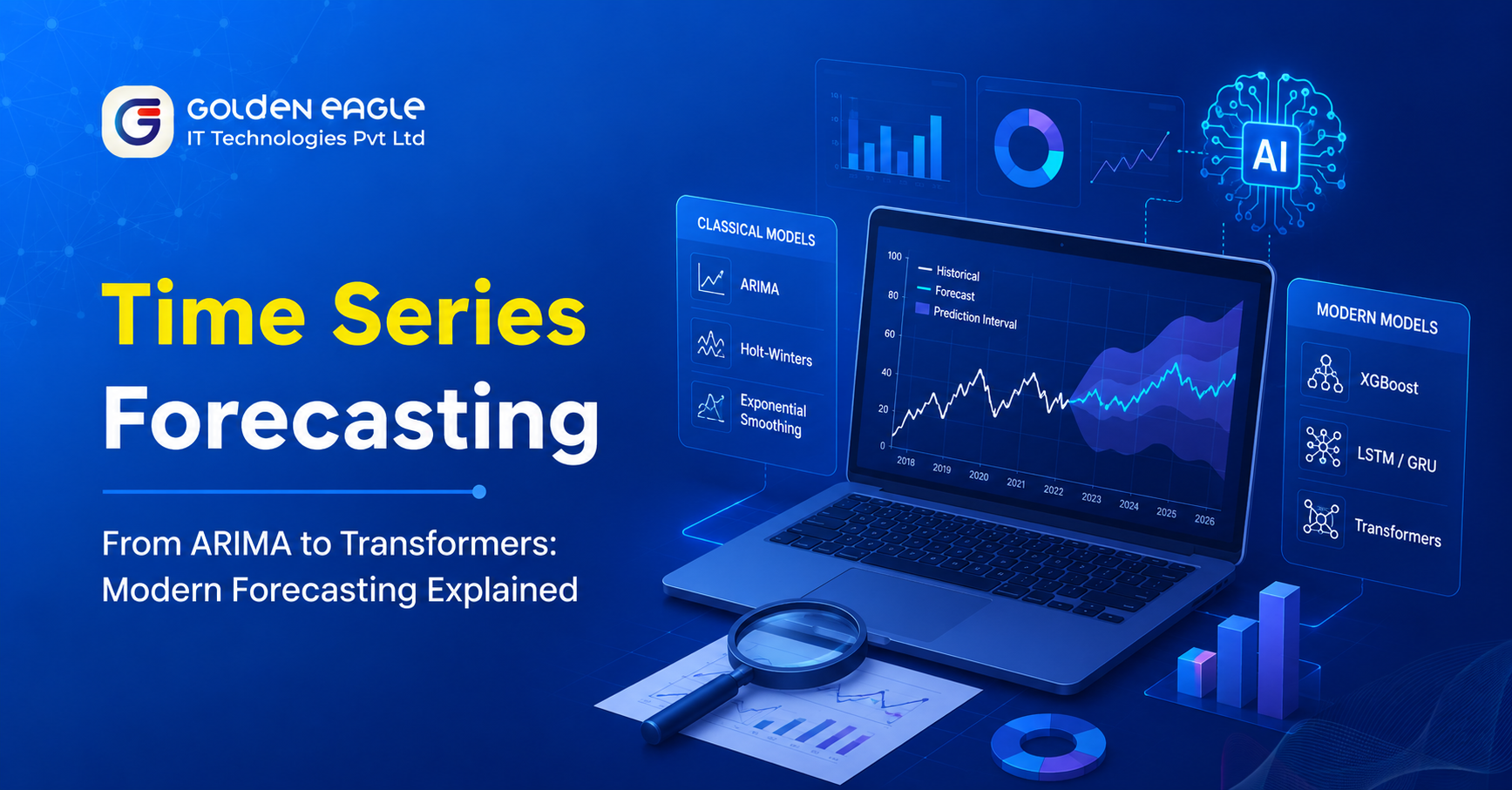
Time series data is one of the most valuable assets for businesses today. From stock market predictions to forecasting electricity demand and sales trends, the ability to predict future outcomes based on historical observations is critical. Time Series Forecasting enables organisations to make informed decisions, optimise resources, and reduce uncertainty.
Unlike traditional datasets, time series data has a temporal dependency, meaning past values influence future outcomes. This makes for
Key Components of Time Series
Understanding the fundamental components of a time series helps in selecting the most appropriate forecasting model.
Trend
A long-term upward or downward movement in data over time, such as rising inflation rates or growing online sales.
Seasonality
Regular and repeating patterns occur at fixed intervals, such as holiday shopping spikes or daily website traffic fluctuations.
Cyclic Patterns
Long-term fluctuations that occur over varying periods are often influenced by economic or business cycles.
Noise
Random variations that do not follow a recognisable pattern can make forecasting more difficult.
Classical Forecasting Approaches
1. ARIMA (AutoRegressive Integrated Moving Average)
ARIMA uses historical observations and past forecasting errors to predict future values. It is highly effective for short-term forecasting when data patterns remain relatively stable.
2. Exponential Smoothing (Holt-Winters)
This technique assigns greater importance to recent observations while accounting for trend and seasonality. It is widely used in retail demand and sales forecasting.
Modern Machine Learning Approaches
3. Tree-Based Models (XGBoost and LightGBM)
These models transform forecasting into a supervised learning problem using lagged variables and engineered features. They can capture complex nonlinear relationships that traditional statistical methods may miss.
4. Deep Learning Models (LSTM and GRU)
Long Short-Term Memory (LSTM) and Gated Recurrent Unit (GRU) networks are designed to learn sequential dependencies within data. They are particularly useful for long-range predictions such as traffic flow, energy consumption, and customer demand forecasting.
Today, Machine Learning for Time Series is helping businesses improve prediction accuracy by identifying patterns that are difficult to detect using traditional methods alone.
GenAI and Next-Generation Forecasting
5. Transformers for Time Series
Originally developed for natural language processing, Transformer architectures have become increasingly popular in forecasting applications. They can capture long-term dependencies more effectively than many recurrent neural networks and work well with large-scale datasets such as IoT sensor streams and financial market data.
6. AI-Assisted Analytics (A2A)
Modern AI solutions go beyond prediction. AI-assisted analytics can automatically interpret forecasting results, generate business reports, identify anomalies, and recommend actions.
For example, instead of only predicting future sales, AI can suggest inventory optimisation strategies, identify demand risks, and support better operational decisions.
Example: Retail Sales Forecasting
Imagine an e-commerce company analysing three years of sales data. Using Time Series Forecasting models such as XGBoost or Transformers, the business can predict future demand during seasonal events like Black Friday and Diwali. Instead of reacting to inventory shortages, the company can proactively stock products, optimise marketing campaigns, and improve customer satisfaction.
What Is the Best Model for Time Series Forecasting?
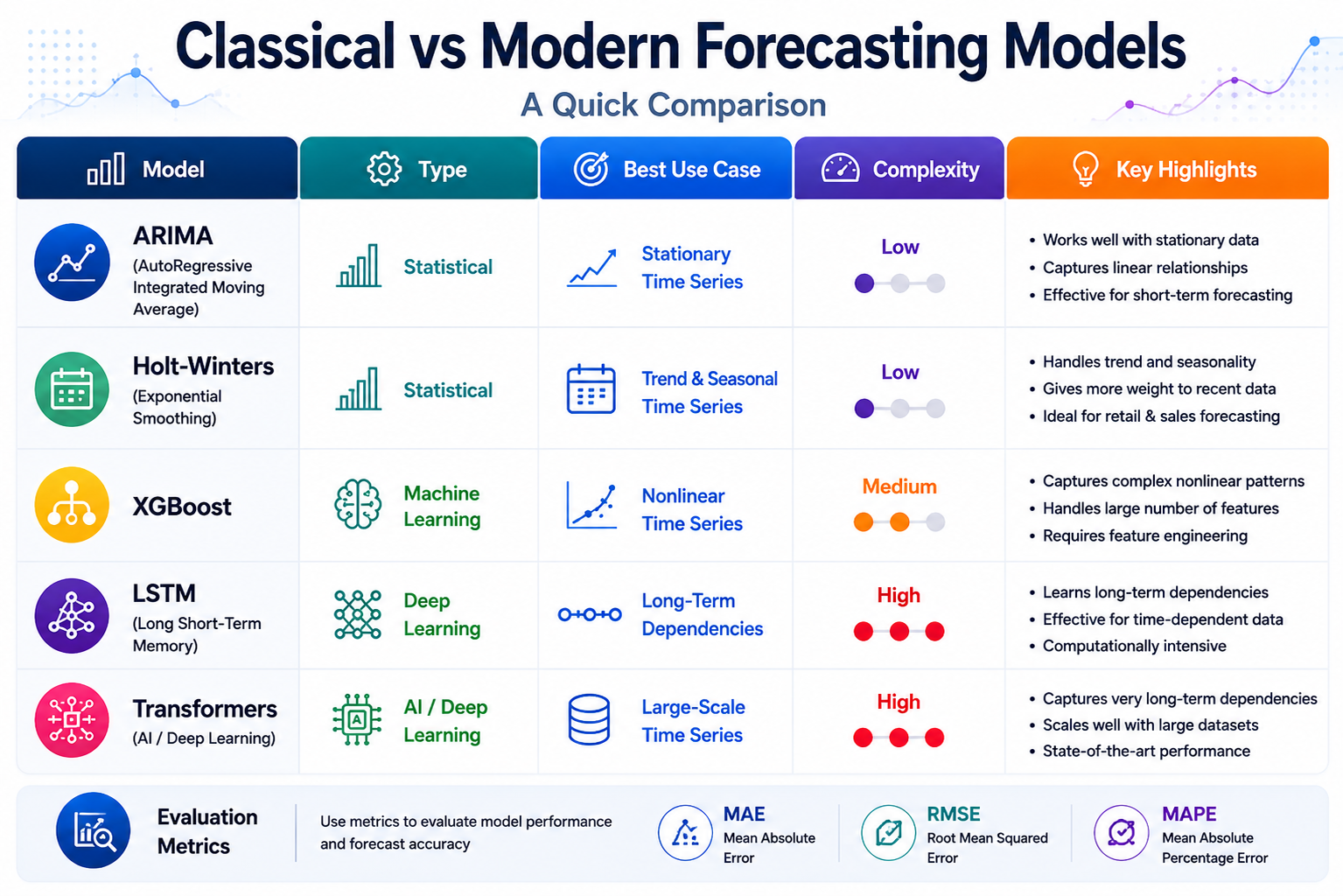
There is no single model that works best for every forecasting problem. The ideal approach depends on the dataset, forecasting horizon, seasonality, and business objectives.
- ARIMA performs well for stable and structured data.
- Holt-Winters is effective when trend and seasonality are dominant.
- XGBoost and LightGBM excel at capturing nonlinear relationships.
- LSTM and GRU are suitable for long-term sequential forecasting.
- Transformers are increasingly considered the state-of-the-art choice for large and complex datasets.
In many modern applications, Machine Learning for Time Series combined with Transformer-based architectures delivers the highest forecasting accuracy and scalability.
Forecast Evaluation Metrics
Selecting the right evaluation metric is essential for measuring model performance.
MAE (Mean Absolute Error)
Measures the average absolute difference between actual and predicted values.
RMSE (Root Mean Squared Error)
Penalises larger prediction errors more heavily, making it useful when significant deviations are costly.
MAPE (Mean Absolute Percentage Error)
Expresses forecasting error as a percentage, making results easier to interpret across different scales.
Real-World Applications
Retail
Forecasting product demand to optimise inventory management and reduce stock shortages.
Energy
Predicting electricity consumption to improve supply planning and grid stability.
Finance
Modeling asset prices, market trends, and interest rate movements.
Healthcare
Monitoring patient vital signs and identifying potential health risks before they become critical.
Conclusion
The field of Time Series Forecasting has evolved significantly over the years.
- Classical models remain effective for stable and low-noise datasets.
- Machine learning techniques provide greater flexibility and capture complex nonlinear patterns.
- GenAI and Transformer-based models represent the next generation of forecasting by delivering enhanced accuracy, scalability, and automated business insights.
The ultimate goal is not simply predicting the next value but enabling smarter, faster, and more data-driven decision-making.
Ready to Turn Your Data into Actionable Insights?
Whether you're looking to forecast sales, optimize inventory, predict customer demand, or build AI-powered analytics solutions, the right forecasting strategy can give your business a competitive advantage.
Contact Golden Eagle IT Technologies today to explore custom AI, machine learning, and predictive analytics solutions tailored to your business needs.
Frequently Asked Questions (FAQs)
1. What is time series forecasting?
Time series forecasting is the process of predicting future values based on historical data collected over time. Businesses use it to forecast sales, demand, energy consumption, stock prices, and other key metrics.
2. What is the best model for time series forecasting?
There is no single best model for every use case. ARIMA works well for stable datasets, while XGBoost, LSTM, and Transformer models are better suited for complex patterns and large-scale forecasting problems.
3. How does ARIMA differ from machine learning models?
ARIMA relies on statistical relationships within historical data, whereas machine learning models can capture nonlinear patterns and incorporate additional features to improve prediction accuracy.
4. Why are Transformer models becoming popular for forecasting?
Transformer models can handle long-term dependencies and large datasets more effectively than traditional recurrent neural networks, making them suitable for modern forecasting applications.
5. What industries use time series forecasting?
Time series forecasting is widely used in retail, finance, healthcare, manufacturing, telecommunications, logistics, and energy sectors to support data-driven decision-making.