




Image source: GeeksforGeeks
Multi-tenancy is a core requirement for modern SaaS products. Rather than deploying and maintaining separate application instances for each customer, a multi-tenant architecture allows multiple tenants to share a single application while ensuring strict data isolation and security.
This guide explains how multi-tenancy works in Rails, compares architectural approaches, and outlines best practices for building scalable, production-ready SaaS applications.
What Is Multi-Tenancy?
Multi-tenancy means a single application instance serves multiple customers, known as tenants. All tenants share the same codebase, but their data is logically isolated.
A well-designed multi-tenant architecture ensures security, scalability, and operational efficiency while supporting long-term SaaS growth.
Approaches to Multi-Tenancy in Rails
1. Shared Database, Shared Schema
All tenants share one database and one schema. Tenant data is separated using a tenant_id column in each table.
Pros
- Simple to implement
- Minimal infrastructure overhead
Cons
- Higher risk of data leakage if queries are not scoped correctly
- Requires proper indexing on tenant_id for performance
2. Shared Database, Isolated Schemas
Tenants share a single database, but each has its own schema. Gems like Apartment or ActsAsTenant can manage schema switching per request.
Pros
- Stronger isolation than shared schema
- Easier to enforce tenant-specific constraints
Cons
- Migrations must be run across all tenant schemas
- Increased operational complexity
3. Isolated Databases
Each tenant has its own database.
Pros
- Maximum data isolation and security
- Ideal for large or enterprise tenants
Cons
- Higher infrastructure cost
- More complex provisioning and maintenance
Best Practices for Multi-Tenant Rails Apps
Always Scope Queries Explicitly
Avoid using default_scope for tenant scoping. It can introduce subtle bugs, especially with joins and background jobs. Prefer explicit tenant-aware scopes:
class Project < ApplicationRecord
def self.for_current_tenant
where(tenant_id: Current.tenant.id) if Current.tenant
end
end
Use Middleware for Tenant Switching
Identify the tenant from the request (subdomain, domain, or headers) and store it in a Current context:
class TenantMiddleware
def initialize(app)
@app = app
end
def call(env)
request = Rack::Request.new(env)
subdomain = request.host.split(".").first
Current.tenant = Tenant.find_by!(subdomain: subdomain)
@app.call(env)
ensure
Current.tenant = nil
end
end
Isolate Background Jobs
Background jobs must execute in the correct tenant context. Sidekiq and Active Job do not handle this automatically.
class TenantAwareJob < ApplicationJob
around_perform do |job, block|
Current.tenant = Tenant.find(job.arguments.first[:tenant_id])
block.call
ensure
Current.tenant = nil
end
end
For schema- or database-based isolation, tenant-specific connections may be required.
Security First
-Never trust user input to determine tenant context
-Enforce tenant isolation at the database level whenever possible
-Validate tenant context across controllers, jobs, and services
Test with Multiple Tenants
Multi-tenant bugs often appear only under cross-tenant conditions. Your test suite should simulate multiple tenants to catch data leakage early.
let(:tenant) { create(:tenant) }
let(:other_tenant) { create(:tenant) }
let(:project) { create(:project, tenant: tenant) }
Choosing the Right Multi-Tenant Approach
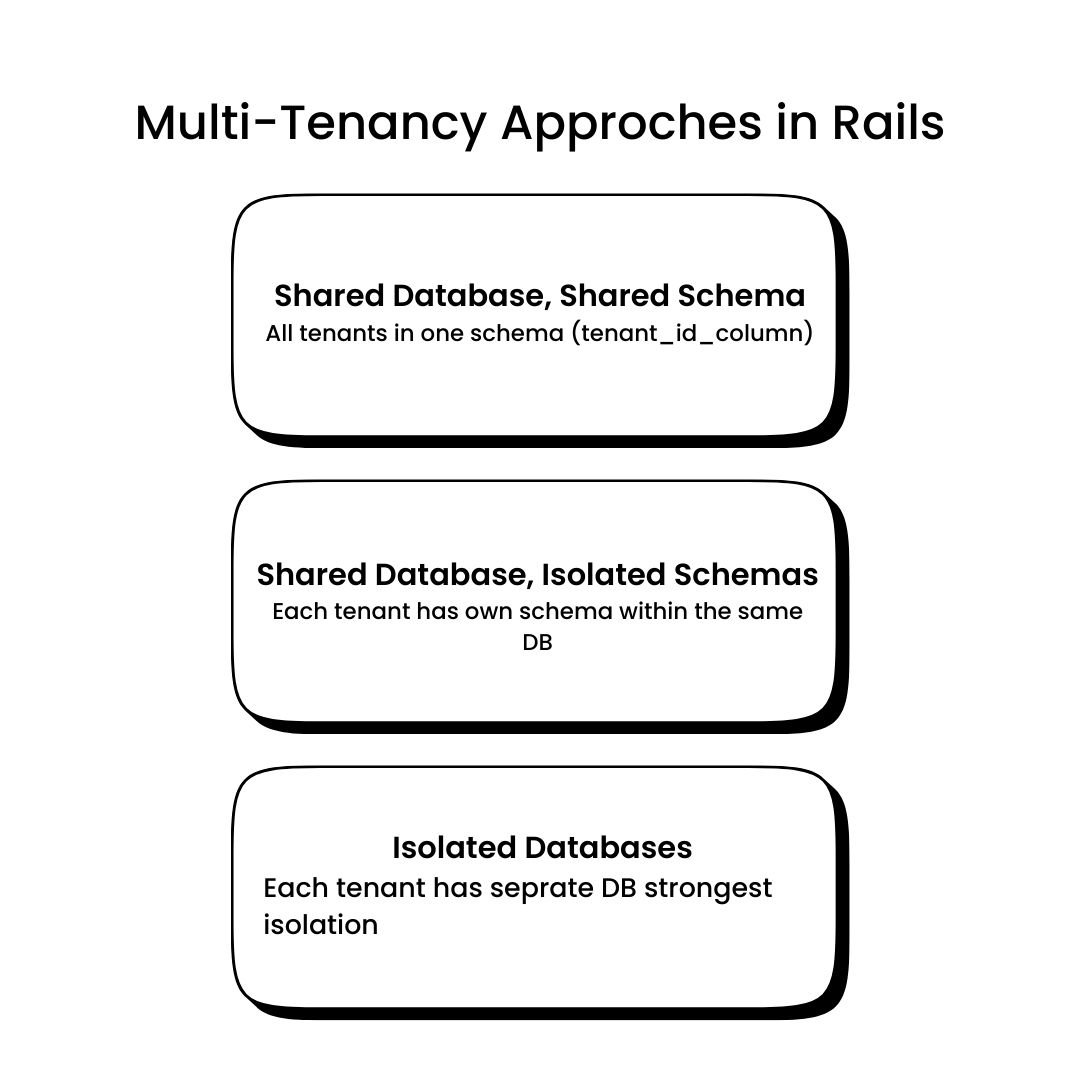
- -Shared schema: Best for MVPs and early-stage SaaS products
- -Separate schemas: Balanced approach for growing applications
- -Separate databases: Best for enterprise SaaS and compliance-driven use cases
Conclusion
Building a multi-tenant Rails application requires deliberate architectural decisions. The right approach depends on scale, compliance requirements, and long-term growth. By scoping queries correctly, isolating tenants at the middleware level, securing background jobs, and testing rigorously, you can build a SaaS platform that scales without compromising data integrity.
Ready to build a scalable, secure multi-tenant Rails application? Partner with our expert Rails development team to implement the right architecture for your SaaS and launch faster. Book a Free Consultation
Frequently Asked Questions
What is multi-tenancy in a Rails application?
Multi-tenancy allows a single Rails application to serve multiple customers while keeping their data logically isolated within the same codebase.
Which multi-tenant architecture is best for my SaaS app?
Shared schema works for small apps, separate schemas offer balanced isolation, and separate databases are best for enterprise-grade security.
How does Rails handle tenant switching?
Rails applications typically use middleware to detect the tenant from a subdomain, domain, or headers and store it in a Current context.
Why is query scoping critical in multi-tenant systems?
Proper scoping prevents data leaks, ensures compliance, and protects customer trust in SaaS platforms.