






Introduction
In modern digital platforms, search is no longer just a feature — it is a critical part of the user experience. Whether it’s an e-commerce platform, SaaS application, enterprise portal, or knowledge base, users expect fast, relevant, and intelligent search results.
This is where Elasticsearch Full-Text Search (FTS) becomes essential. Built on top of Apache Lucene, Elasticsearch is a distributed and scalable search engine designed to process massive amounts of structured and unstructured data in near real-time.
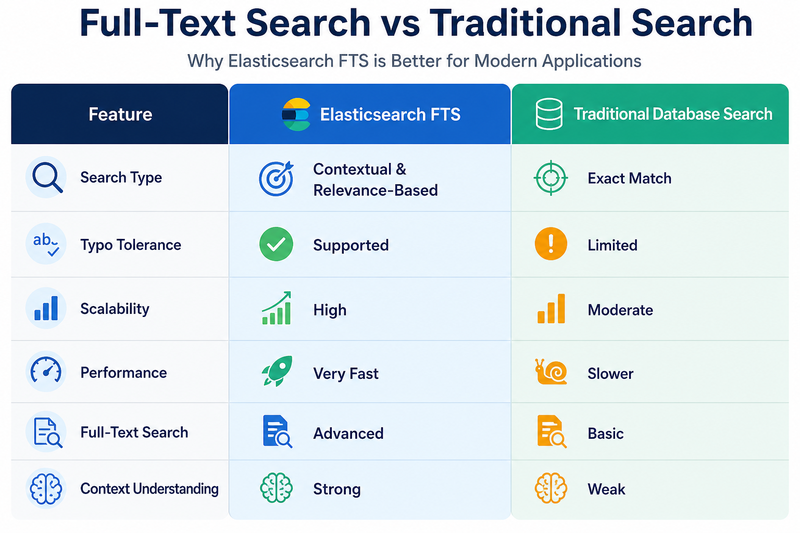
Unlike traditional keyword-based search systems, Elasticsearch Full-Text Search understands context, relevance, and language variations to deliver more accurate and meaningful search experiences.
What is Full-Text Search?
Full-text search is a search technique that scans entire documents instead of matching only exact keywords or database fields.
Traditional SQL searches depend heavily on exact string matching, which limits search quality and flexibility. Elasticsearch Full-Text Search improves this by enabling:
- Typo tolerance
- Synonym recognition
- Context-aware ranking
- Intelligent relevance scoring
This allows users to find relevant information even when search queries are incomplete, misspelled, or phrased differently.
Why Elasticsearch is Important for Modern Search
Traditional databases often face challenges such as:
- Slow query performance
- Poor handling of unstructured data
- Limited contextual understanding
- Scalability limitations
Elasticsearch solves these issues by:
- Using advanced indexing mechanisms
- Delivering near real-time search results
- Supporting distributed scalability
- Providing intelligent relevance ranking
This makes Elasticsearch a preferred choice for modern search-driven applications and AI-powered systems.
How Elasticsearch Full-Text Search Works
1. Indexing (The Foundation)
Before a search can happen, data must be indexed. Elasticsearch stores data as JSON documents, where each field is analyzed and converted into searchable tokens.
These tokens are stored inside an inverted index, allowing Elasticsearch to retrieve results quickly without scanning entire datasets.
Benefits of Indexing:
- Faster search performance
- Real-time retrieval
- Efficient large-scale querying
- Optimized storage and access
2. Text Analysis Pipeline
Every text field in Elasticsearch passes through an analysis pipeline that helps normalize and optimize searchable content.
The pipeline includes:
Character Filters
Clean and normalize raw input text.
Tokenizers
Break text into smaller searchable units called tokens.
Token Filters
Apply transformations such as:
- Lowercasing
- Stemming
- Stop-word removal
- Synonym handling
This process improves match accuracy and search relevance.
3. Query Processing
When users perform a search, Elasticsearch processes the query using the same analysis pipeline used during indexing.
It executes full-text queries such as:
- match
- multi_match
- bool
- query_string
Elasticsearch then evaluates how well documents align with the processed query terms and user intent.
4. Relevance Scoring
Elasticsearch ranks search results using advanced scoring algorithms like BM25.
Ranking factors include:
- Term frequency
- Inverse document frequency
- Field importance
- Query relevance
This ensures users receive the most relevant search results first instead of simple keyword matches.
Key Features of Elasticsearch Full-Text Search
Elasticsearch FTS provides several advanced features that significantly improve search quality and user experience.
Fuzzy Search
Handles typographical errors and misspelled queries.
Synonym Mapping
Recognizes related terms and language variations.
Result Highlighting
Highlights matching content within search results.
Autocomplete & Suggestions
Enables predictive search experiences and recommendation systems.
Horizontal Scalability
Scales efficiently across distributed infrastructures.
Real-World Use Cases of Elasticsearch FTS
Elasticsearch Full-Text Search is widely used across industries for intelligent search and analytics.
E-commerce Platforms
Product discovery, filtering, and intelligent recommendations.
SaaS Applications
Fast data retrieval and dashboard search functionality.
Content Platforms
Enhanced discoverability for blogs, articles, and media libraries.
Enterprise Knowledge Search
Internal document search and centralized knowledge management.
AI & RAG Systems
Retrieval-Augmented Generation pipelines for contextual AI responses.
Log Analytics & Monitoring
Rapid querying and analysis of large-scale log datasets.
Where Elasticsearch Fits in Modern Architecture
In modern architectures, Elasticsearch typically acts as a dedicated search layer alongside a primary database.
Architecture Flow:
- Primary database stores the source of truth
- Elasticsearch handles search operations
- Application layer coordinates interactions between systems
Benefits:
- Reduced database load
- Faster search performance
- Better scalability
- Improved user experience
Common Elasticsearch FTS Pitfalls
Improper implementation can reduce search quality and performance.
Common Issues Include:
- Misconfigured analyzers
- Over-indexing unnecessary fields
- Poor relevance tuning
- Incorrect query usage
- Ignoring shard optimization
Proper Elasticsearch architecture and tuning are critical for achieving optimal search performance.
Business Benefits of Elasticsearch
Organizations using Elasticsearch can achieve:
- Faster search experiences
- Improved customer engagement
- Better data discoverability
- Scalable search infrastructure
- Enhanced analytics capabilities
- Reduced operational bottlenecks
Search quality directly impacts user satisfaction, conversions, and business performance.
Why Businesses Choose Elasticsearch
Elasticsearch is ideal for applications that require:
- Real-time search
- Intelligent search relevance
- AI-powered retrieval systems
- Large-scale data processing
- Distributed scalability
- Enterprise-grade performance
Its flexibility and scalability make it one of the most widely adopted search technologies in modern software architectures.
Conclusion
Elasticsearch Full-Text Search is more than just a search engine capability — it is a foundational technology for building intelligent digital experiences.
By combining advanced indexing, text analysis, contextual ranking, and distributed scalability, Elasticsearch enables businesses to deliver faster, smarter, and more relevant search experiences at scale.
For organizations building modern digital products, implementing Elasticsearch effectively can dramatically improve both operational performance and user satisfaction.
Ready to Build Intelligent Search Experiences?
If your application still relies on traditional search mechanisms, it may be time to explore Elasticsearch Full-Text Search as a dedicated search layer.
Partner with Golden Eagle IT Technologies to build scalable, high-performance, and intelligent Elasticsearch solutions tailored to your business needs.
FAQs (Optimized for Featured Snippets)
1. What is Elasticsearch Full Text Search?
Elasticsearch Full Text Search is a method of searching data based on context and relevance rather than exact keyword matches, delivering fast and accurate results.
2. How does Elasticsearch handle large data?
It uses a distributed system with shards and replicas to ensure scalability, performance, and fault tolerance.
3. Why is Elasticsearch better than SQL for search?
Elasticsearch uses inverted indexing and advanced text analysis, making it faster and more relevant for search queries than traditional databases.
4. Where is Elasticsearch used?
It is used in e-commerce, log analytics, enterprise search, SaaS platforms, and AI-driven applications.
5. Do I need an Elasticsearch consulting service?
Yes, for large-scale or business-critical applications, experts help optimize performance, scalability, and infrastructure.