





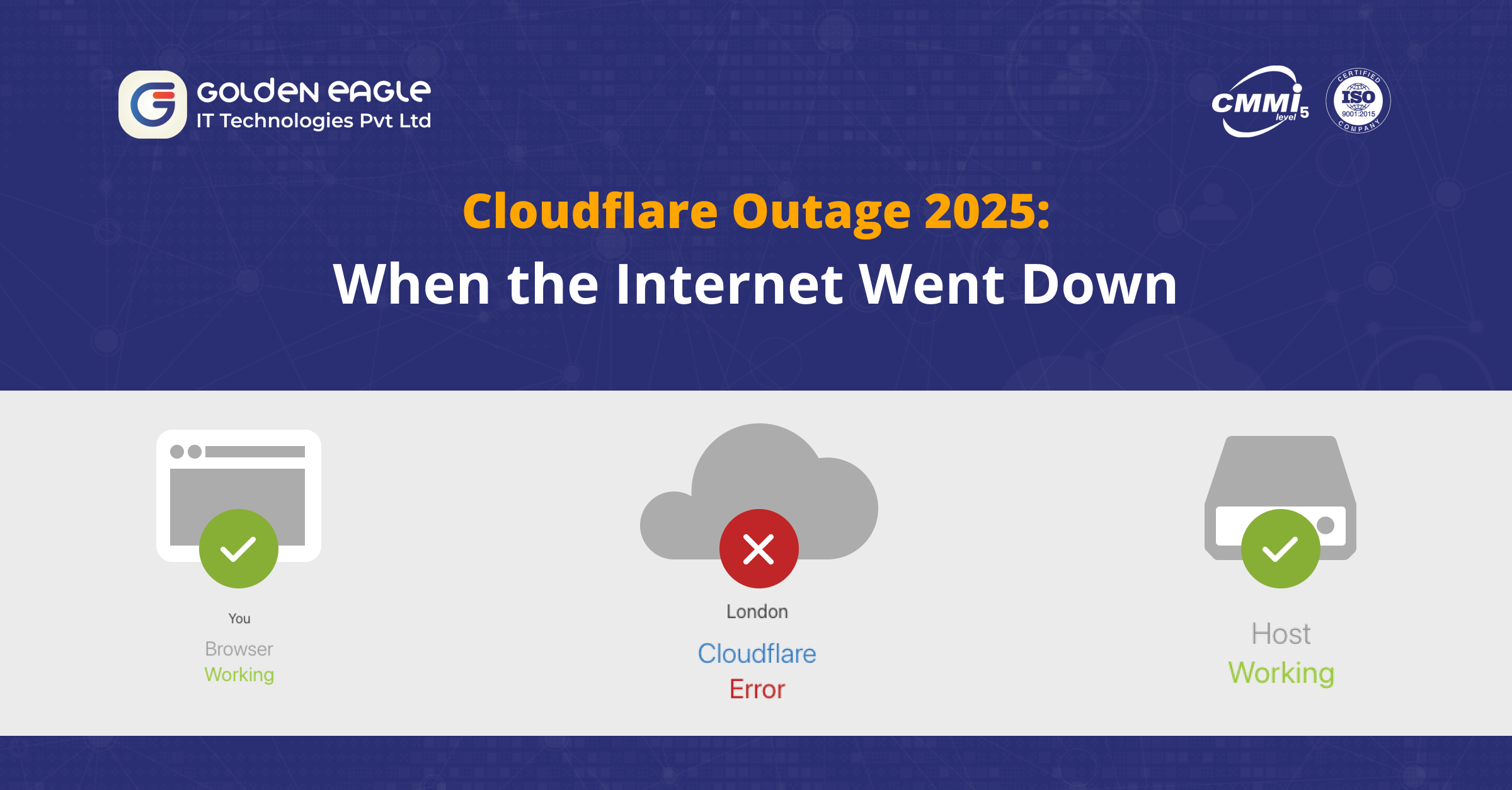
Learn how the Nov 18 2025 Cloudflare outage hit ChatGPT, Discord, Shopify and X plus key tactics to boost digital resilience and multi-CDN continuity.
TL;DR – Quick Summary
-When: November 18, 2025
-Duration: Several hours of widespread disruption
-Cause: A database permissions update triggered a latent bug in Cloudflare bot management, affecting critical Cloudflare services
-Impact: Major platforms, including ChatGPT, Canva, Discord, Shopify, and X became inaccessible
-Root Issue: Auto-generated configuration file exceeded a 200-feature limit, crashing traffic services
-Key Lesson: Even distributed, resilient infrastructure supported by cloudflare security l ayers can fail due to minor configuration changes
The Day the Internet Stuttered
In a digital-first world, uptime and global distribution are often assumed. The November 18, 2025 Cloudflare global outage shattered that assumption. For hours, users worldwide were locked out of platforms like ChatGPT, Canva, Discord, Shopify, and X—even though their internal systems were fully operational.
The disruption originated Cloudflare services, a critical piece of internet infrastructure. A single configuration problem temporarily blocked millions of users from reaching otherwise healthy services. This was a real-time lesson in how central dependencies can ripple across the global digital ecosystem.
What Actually Happened
The incident began during a standard permissions update in Cloudflare’s ClickHouse database. Engineers were adjusting security configurations to ensure system processes operated under specific database identities.
The update triggered a latent bug in cloudflare bot management, which duplicated feature metadata used for traffic filtering. The resulting auto-generated configuration file exceeded the 200-feature limit, crashing Cloudflare’s traffic-handling services.
As the oversized configuration file propagated globally, it caused HTTP 500–503 errors, blocking both human and automated access to countless websites. The internet itself didn’t fail—the gateway to it did.
Why the Impact Was So Widespread
Most users only notice Cloudflare when something breaks. Behind the scenes, it acts as a multi-layered traffic manager, supporting a large portion of the web.
Cloudflare handles:
-Global CDN acceleration for faster content delivery
-DDoS protection through cloudflare security layers
-DNS resolution to guide browsers to servers
-Firewalls, API gateways, and session validation
-Authentication challenges and bot screening
When this bridge collapses, even robust platforms like ChatGPT or Shopify become inaccessible.
What Users Experienced
During the outage, users saw:
-“Access Denied” or “Blocked by Cloudflare” messages
-Blank login screens
-Session timeouts with no response
-CAPTCHA loops that never resolved
Businesses faced workflow delays, frozen dashboards, blocked authentication, and downtime across critical tools.
The Root Cause: Small Errors, Big Consequences
The outage wasn’t a cyberattack or infrastructure failure. It resulted from a cascading sequence of small issues:
-A routine database permissions update
-A hidden bug in Cloudflare bot management
-A rigid feature limit exceeded unexpectedly
Modern system failures rarely stem from a single error—they arise from unexpected interactions. This mirrors previous CDN outages, including Fastly in June 2021.
How Cloudflare Investigated and Recovered
Initially, engineers suspected a large-scale attack. The sporadic recovery followed by repeated failure indicated otherwise.
Investigation revealed the bot management file, regenerated every five minutes, exceeded the feature limit only on nodes that received the new permissions update, explaining staggered failures.
Recovery steps:
-Rolled back the database permission change
-Replaced the corrupted configuration with a known-good version
-Rebooted core proxy services globally
Most platforms were restored within hours. Cloudflare’s dashboard and internal authentication systems took longer due to dependencies on impacted components.
Why This Matters for Every Business
The critical takeaway isn’t downtime—it’s systemic fragility in modern digital architecture.
1. Even Highly Engineered Systems Can Fail
Cloudflare is one of the most resilient infrastructures, yet a configuration chain reaction caused global disruption. No provider is immune.
2. Single-Vendor Dependency Is Risky
Relying solely on one CDN or DNS provider exposes businesses to unnecessary risk. Multi-CDN strategies and automated failover should be baseline architecture requirements.
3. Transparency Builds Trust
Cloudflare’s postmortem helped businesses understand the issue rather than speculate. Incident transparency should be a standard for all critical service providers.
4. Status Pages Are Not a Resilience Strategy
Monitoring alone is reactive. True resilience requires:
-Proactive performance monitoring
-Fallback routing and failover mechanisms
-Regular chaos-style testing to validate recovery plans
Actionable Steps for Business Continuity
-Implement multi-CDN architectures with regional failovers
-Diversify DNS providers to avoid single points of failure
-Test disaster recovery plans regularly
-Invest in automated monitoring for early anomaly detection
-Train IT and DevOps teams on resilience best practices
These steps mitigate risk and protect your digital operations from future disruptions.
The Bigger Picture: Digital Resilience as a Strategic Imperative
The Cloudflare outage illustrates that the internet is not a monolith but a fragile network of interdependent services, protocols, APIs, and automation systems.
Future resilience relies on:
-Geographic redundancy across multiple providers
-Automated failover mechanisms
-Diverse technology stacks independent of a single vendor
-Regular disaster recovery testing
Businesses treating resilience strategically gain a significant competitive advantage.
Final Thought
The Cloudflare outage didn’t break the internet—but it exposed its underlying fragility. Digital reliability is defined by preparedness, redundancy, and the ability to recover at scale.
In a world built on digital trust, resilience is not optional—it’s foundational.
Ready to strengthen your digital infrastructure?
Subscribe to our newsletter for weekly insights on web performance, security, and resilience. Or contact our team today to implement multi-CDN strategies and robust business continuity planning.
Related Resources
- Cloudflare’s Official Incident Report
- Understanding CDN Architecture and Redundancy
- Building Resilient Digital Infrastructure: A Complete Guide
- Download: Website Resilience Checklist
Frequently Asked Questions
How long did the Cloudflare outage last?
Several hours, with gradual recovery beginning in the early afternoon UTC.
Which websites were affected?
ChatGPT, Canva, Discord, Shopify, X, and other sites using Cloudflare’s CDN, DNS, or security services.
How can I check if Cloudflare is down?
Monitor Cloudflare Status or third-party tools like DownDetector.
What caused the outage?
A routine database permissions update triggered a latent bug in Cloudflare’s bot management system.
How can businesses protect themselves?
Use multi-CDN strategies, automated failover, diverse DNS providers, and regular disaster recovery testing.